
Every consultancy I know has one.
A framework you're proud of. Built over years. Tested on real clients. Drawn beautifully on slide 4 of the pitch deck.
And then it sits there.
It comes out in the pitch. You talk it through with real energy. Everyone nods. Then the engagement starts and the framework goes back in the drawer, because there's no easy way to actually use it on a client.
That's what I mean by a memory, not a method. A method is something you can run. On every client. The same way. With a score at the end.
I recorded a video of myself doing exactly that with my own framework, live and start to finish. This is the written version, step by step, so you can do the same with yours.
Step 1. Start with the framework you already have
At The ALY Collective, our method is three questions, answered in order:
- Aim. Who we go after, and why they'd buy now.
- Language. What we say, and how it lands.
- Yield. Turning attention into signed contracts.
Then we make it repeatable, so it keeps working after we've gone. It lives in a 14-page PDF. Nothing fancy about the format.
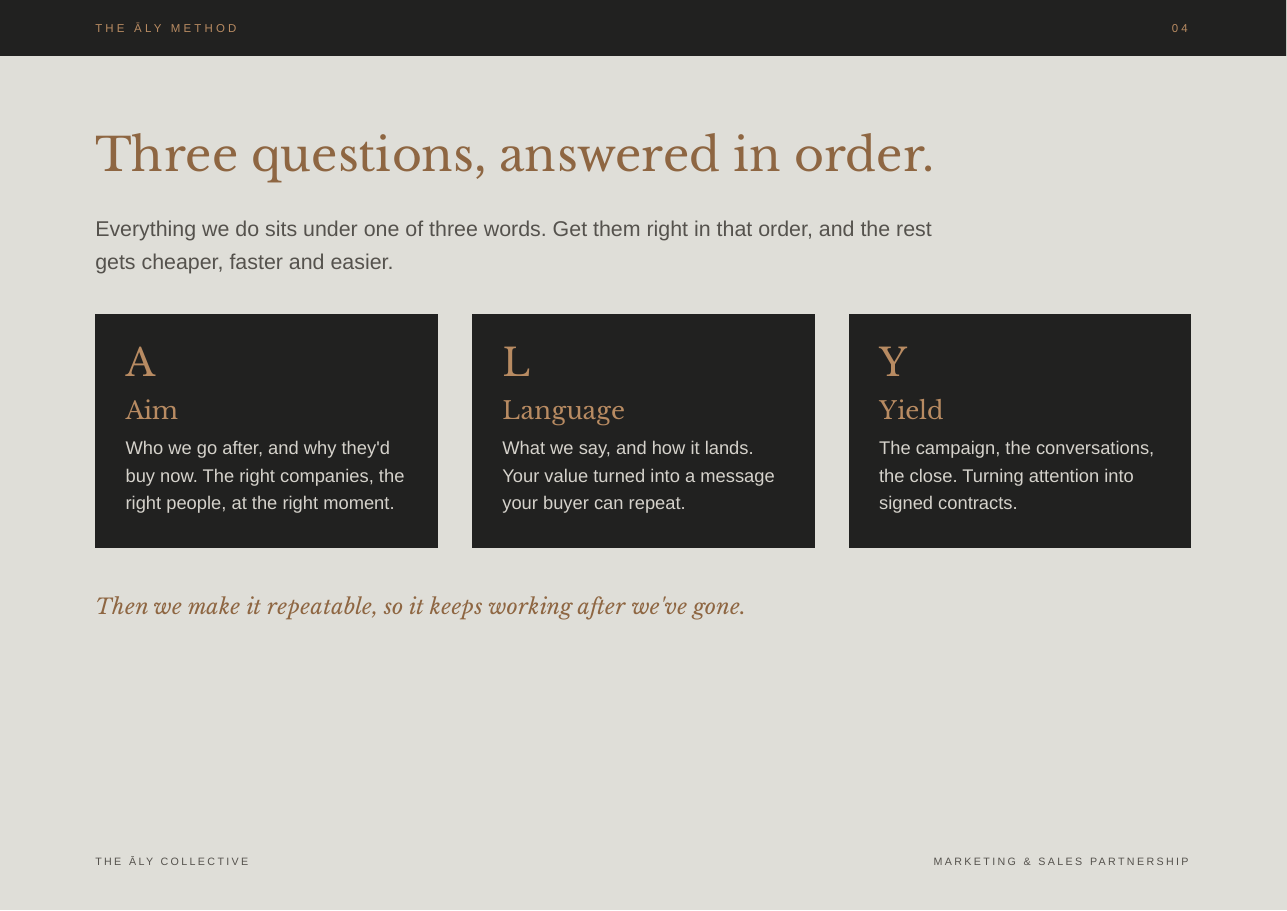 Page 4 of our framework. The thinking we wanted to turn into something we could score.
You don't need to rewrite anything. If your framework is written down somewhere, in a PDF, a deck or a spreadsheet, you're ready.
Step 2. Upload it and choose how people will answer
In Score-AI, I created a new questionnaire and uploaded the PDF as a context file. Then I chose the question types I was happy for it to use:
- maturity ratings from one to five
- multiple choice
- yes or no
- yes, no or partial
- open text for a bit of colour
I also switched on conditional deep-dives. People only get follow-up questions when their answer calls for one. Depth where it matters, without wearing everyone out.
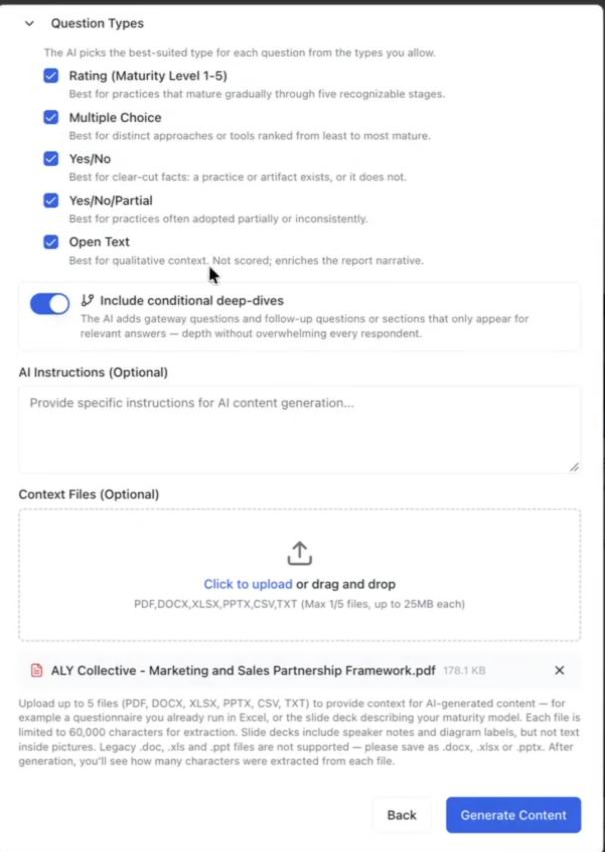 The framework PDF attached, question types chosen, deep-dives switched on.
Then I clicked Generate Content.
Step 3. Check what it built
This is the bit that got me. It came back with 23 questions across five areas. And the areas were mine:
- Aim: Who You Pursue and Why Now
- Language: Message, Proof and Value
- Yield: Campaign and Conversation
- Ownership: Pipeline, Qualification and Close
- Repeatability: Measurement, Playbook and Leadership Rhythm
It had read the framework properly. It even split our "make it repeatable" step into ownership and repeatability, which is how we actually work with clients.
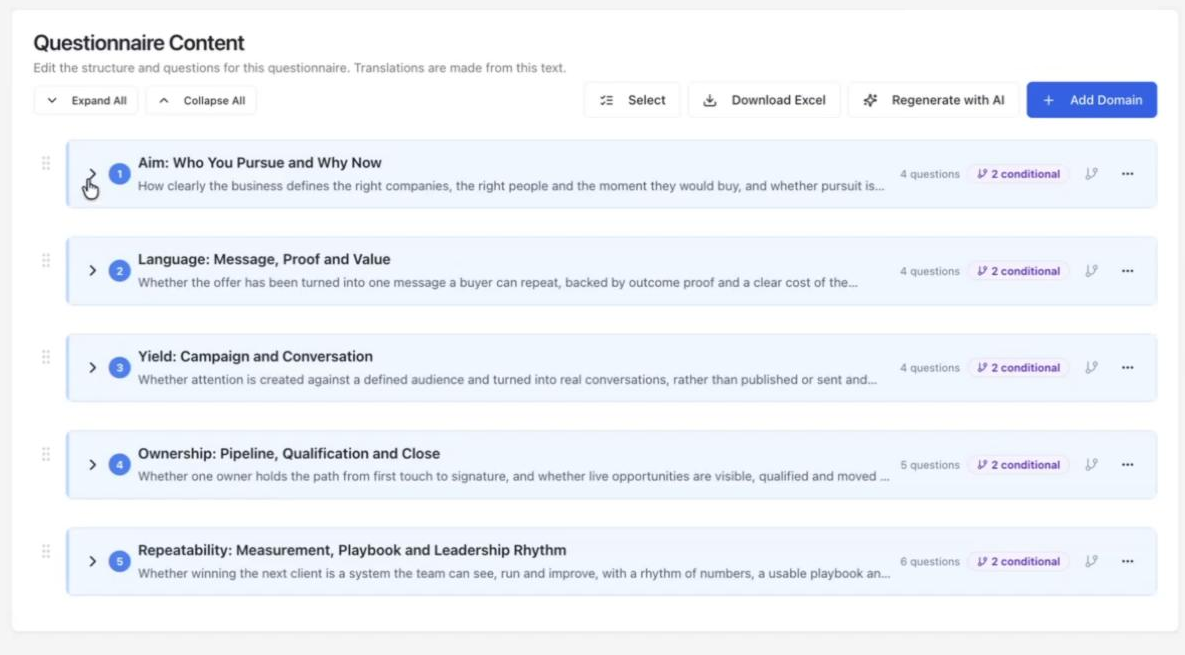 Five areas, 23 questions, each area with conditional follow-ups.
Step 4. Read the questions like a client would
Don't skip this. Open a few questions and read them slowly. These are the words your client will see.
Here's the first one under Aim. It asks how clearly the firm defines its ideal client. There are five answers, scored from one to five. They run from "We have no shared definition of an ideal client" all the way to "A written profile is agreed, used in pursuit decisions, and updated from who we win, keep and lose."
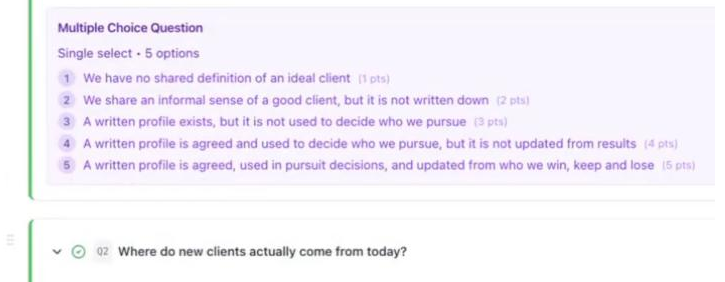 One question. Five levels of maturity. Each one scored.
That's the difference between a framework and a method. The slide said "know your ideal client". This tells you how well a client actually does it.
If something isn't right, change it. You can edit any question, add an area, or regenerate.
Step 5. Turn it into a campaign
Once you're happy, you create a campaign. You choose whether it's for one named client or open to any company.
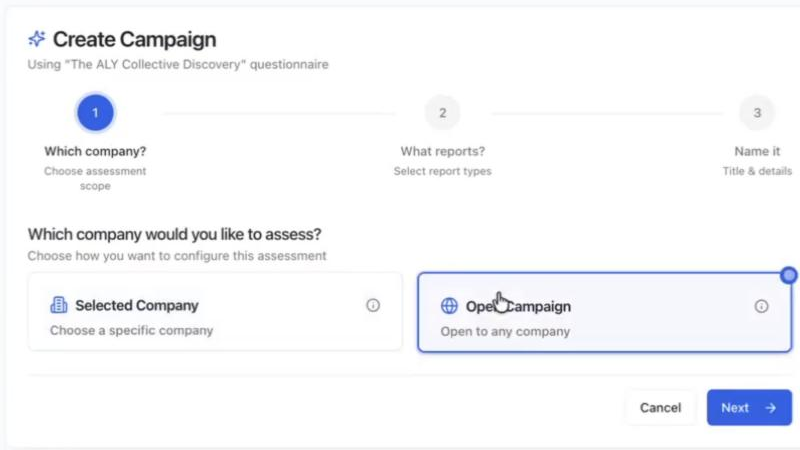 One named client, or an open campaign anyone can take.
This choice matters more than it looks:
- An open campaign is a lead magnet. People find it, take it and learn something about themselves.
- A named campaign is a paid diagnostic. Every stakeholder in one client, the same questions, one clear picture.
Same questions. Two very different jobs.
Step 6. Share it
That's it. It's live. You can invite people by name, share it on social, or copy a link to drop into an email or onto your website.
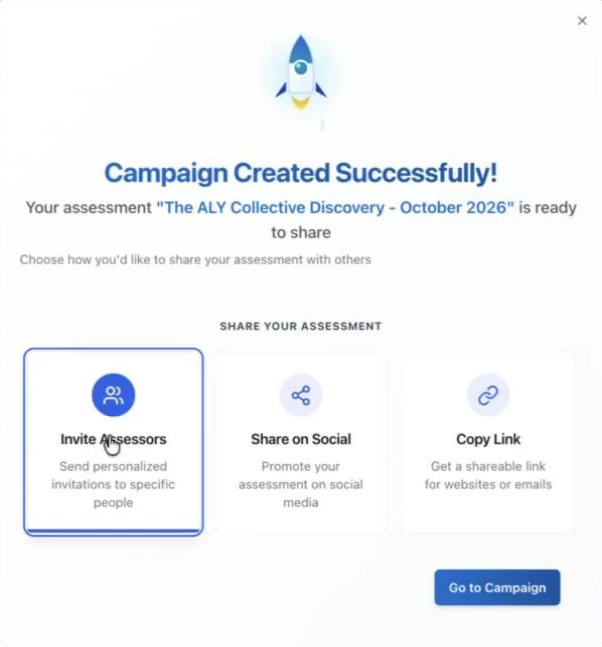 Live and ready to share.
Step 7. See it the way your client will
I always check this last. The client clicks the link. They answer a few quick questions about their role, then go straight into the assessment. No login. No account to set up.
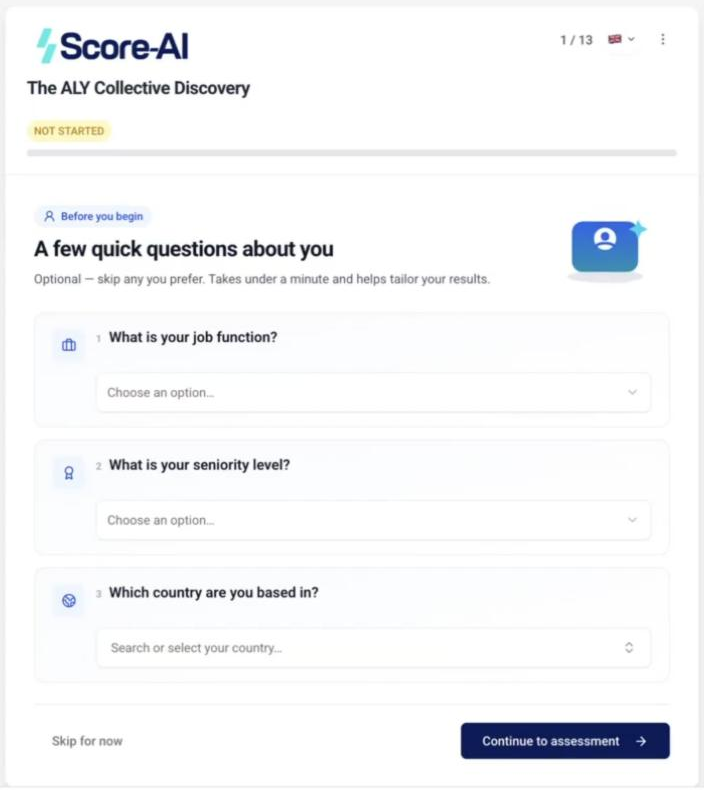 The first thing your client sees.
Why this matters
Once your framework can be run like this, a few things change.
- Discovery stops being free advice. It becomes a scored diagnostic with your thinking behind every question. Something a client can see the value in, and pay for.
- Everyone gets heard. Every stakeholder answers the same questions. So you find out where the founder and the head of sales see things differently before you're in the room, not halfway through the project.
- You get a baseline. A real starting point, in the client's own answers. Run it again at the end of the work and the change is right there. If you've been following our posts on outcome-based pricing, this is the piece that makes it possible.
- Your method becomes repeatable. It doesn't depend on who runs the workshop or how much time the team had that week. It runs the same way every time.
Before you try it
A few things I'd tell anyone doing this for the first time:
- Use the framework you actually work from. Not the polished version for the website. The real one. The better your thinking, the better the questions.
- Read every question before it goes out. The draft is a strong start. Your judgement is what makes it yours.
- Decide the job first. Lead magnet or paid diagnostic? Pick one and set up the campaign for that.
- Take it yourself. Before a client ever sees it, answer it as if you were them. You'll spot anything that feels off straight away.
Your framework already works
You know it does. You've seen it work with clients. This just gets it out of the deck and in front of the client, where it can actually do something.
If you want to watch me do it live, start to finish, the full demo is here.

Data-obsessed marketing leader. Ex-NetApp Head of EMEA and LATAM Marketing. 7 years at SAP Fieldglass. Certified coach.
Connect on LinkedIn